
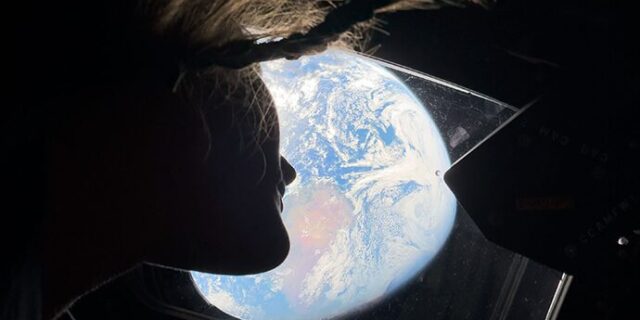
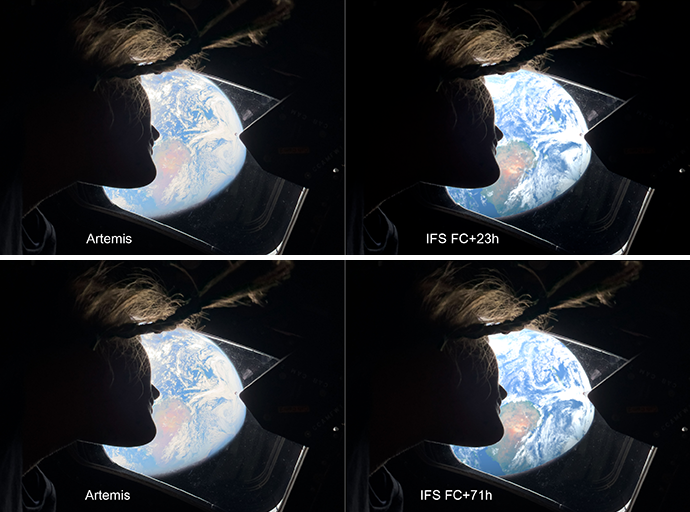
RTTOV-simulated views of Earth from Artemis II at ECMWF
(Left) Astronaut Christina Koch enjoying the view.
Camera: iPhone 17 Pro Max
Date and time: 2 Apr 2026, 22:44:38 UTC
Image credit: NASA (CC BY-NC-ND 4.0)
(Right) RTTOV simulations.
DOI: 10.21957/98f398df53
When astronauts aboard NASA’s Artemis II mission turned their cameras back toward Earth in April 2026, they captured striking views of our planet—half-lit by the Sun, glowing faintly at night, and even framed by aurorae and distant planets. These images, taken from a trajectory on the way to the Moon, offered perspectives rarely seen outside the Apollo era. At ECMWF, these photographs became the inspiration for an unusual scientific exercise: could a weather forecasting model reproduce exactly what the astronauts saw?
In a recent ECMWF blog article (DOI 10.21957/98f398df53), Philippe Lopez describes how images of Earth taken by astronauts during the Artemis II mission (April 2026) were reproduced using the Integrated Forecasting System (IFS) and, at its core, the EUMETSAT NWP SAF fast radiative transfer RTTOV.
RTTOV is a fast radiative transfer model designed to convert atmospheric profiles (temperature, humidity, clouds, trace gases) and viewing geometry into top-of-atmosphere radiances—essentially, the light that a satellite or camera would detect. In the Artemis II simulations, RTTOV takes the IFS forecast state and computes how radiation travels through the atmosphere, accounting for absorption, emission, and scattering processes, and produces simulated radiances that can be mapped into realistic images.
These conditions push radiative transfer modelling well beyond its routine use in data assimilation. The success of the simulations demonstrates how RTTOV, combined with high-quality NWP output, is capable of dealing with these non-standard geometries and conditions.
While recreating astronaut photographs is visually appealing, the implications go further. The same combination of NWP and radiative transfer underpins many operational applications. This experiment highlights RTTOV’s broader value as more than just an assimilation tool, but a wide range and applicability observation operator, capable of translating model physics into observable reality … even from the edge of space.